Heavy-duty girder cranes for fabrication shops, steel service centers, precast yards, and maintenance bays. Bridge, gantry, or semi-gantry — span, hook height, and duty class specified right before the bid package goes out.
Nearly every other choice follows from this one. It is not simply a question of how much steel you buy. Where the trolley sits relative to the girder changes how high the hook can go, how close it can get to each end of the bay, and what you can hang below it.
Consideration
Single girder
Double girder
Trolley position
Hangs below the girder
Rides on top of both girders
Hook height
Reduced by the trolley body below the beam
Highest available in the same building
Hook approach
Larger dead zone at each end of the span
Closer approach to the runway on each end
Typical capacity range
Light to moderate; commonly under about 20 tons
Moderate to very heavy, with no practical ceiling
Typical span range
Short to medium spans
Comfortable at long spans
Bridge dead weight
Lighter, so lower wheel loads on the runway
Heavier, so a stronger runway and columns
Below-hook equipment
Limited room for magnets, grabs, cabs
Room for cabs, magnets, coil grabs, rotators
Walkways and service access
Rarely practical
Walkway alongside the girders is standard
Relative cost
Lower purchase and lower installed cost
Higher on both, and on the supporting structure
Where single girder is the right call
Loads that sit comfortably inside the capacity range, a bay with headroom to spare, a duty cycle that is measured in lifts per shift rather than lifts per hour, and a budget that has to cover the runway as well as the crane. Under those conditions the extra girder buys you very little.
Where double girder earns its price
Tight buildings where hook height is the binding constraint. Long spans. Capacities beyond what a single beam carries economically. Any application needing a cab, a magnet, a rotating grab, or a service walkway along the bridge. And heavy duty cycles, where the extra structure is what keeps the crane out of the repair log.
Configurations
Bridge, gantry, semi-gantry and jib
The question behind this choice is simple: what is going to hold the crane up? A building that can carry crane loads gets a bridge crane. A building that cannot, or no building at all, gets a gantry. Everything else is a variation on that answer.
The workhorse
Top running double girder bridge crane
Two girders span the bay, and the hoist trolley rides on rails laid across the top of both. Because the trolley sits above the girders rather than below them, the hook can be pulled higher and further toward the runway on each end. This is the configuration you specify when capacity is high, the span is long, or every inch of lift matters.
Strengths
+Highest available hook height for a given building
+Handles the heaviest capacities and longest spans
+Accommodates walkways, cabs, magnets and below-hook equipment
Trade-offs
−Highest cost per crane and heaviest wheel loads
−Needs more headroom above the runway rail
The economical span
Top running single girder bridge crane
One girder carries the load, with the hoist trolley hung underneath the bottom flange. The end trucks still ride on top of the runway rails, so the crane keeps decent hook height while cutting the bridge steel roughly in half. For light and moderate duty work under about 20 tons, this is often the right answer.
Strengths
+Notably lower purchase and installation cost
+Lighter dead weight means smaller runway and column loads
+Simpler structure, fewer components to maintain
Trade-offs
−Hook height and hook approach are reduced by the underhung trolley
−Practical capacity and span ceiling is lower
The retrofit
Underhung (under running) bridge crane
The whole crane hangs from the bottom flange of the building's roof beams instead of riding on a dedicated runway. That eliminates runway columns entirely, which is why it shows up so often in existing buildings and in assembly areas where floor space cannot be given up. The building structure has to be checked for the added load.
Strengths
+No runway columns consuming floor space
+Can transfer between bays with interlocks and switches
+Good fit for lighter loads in an existing structure
Trade-offs
−Capacity is limited by the building steel it hangs from
−Requires a structural review of the existing roof framing
Where there is no building
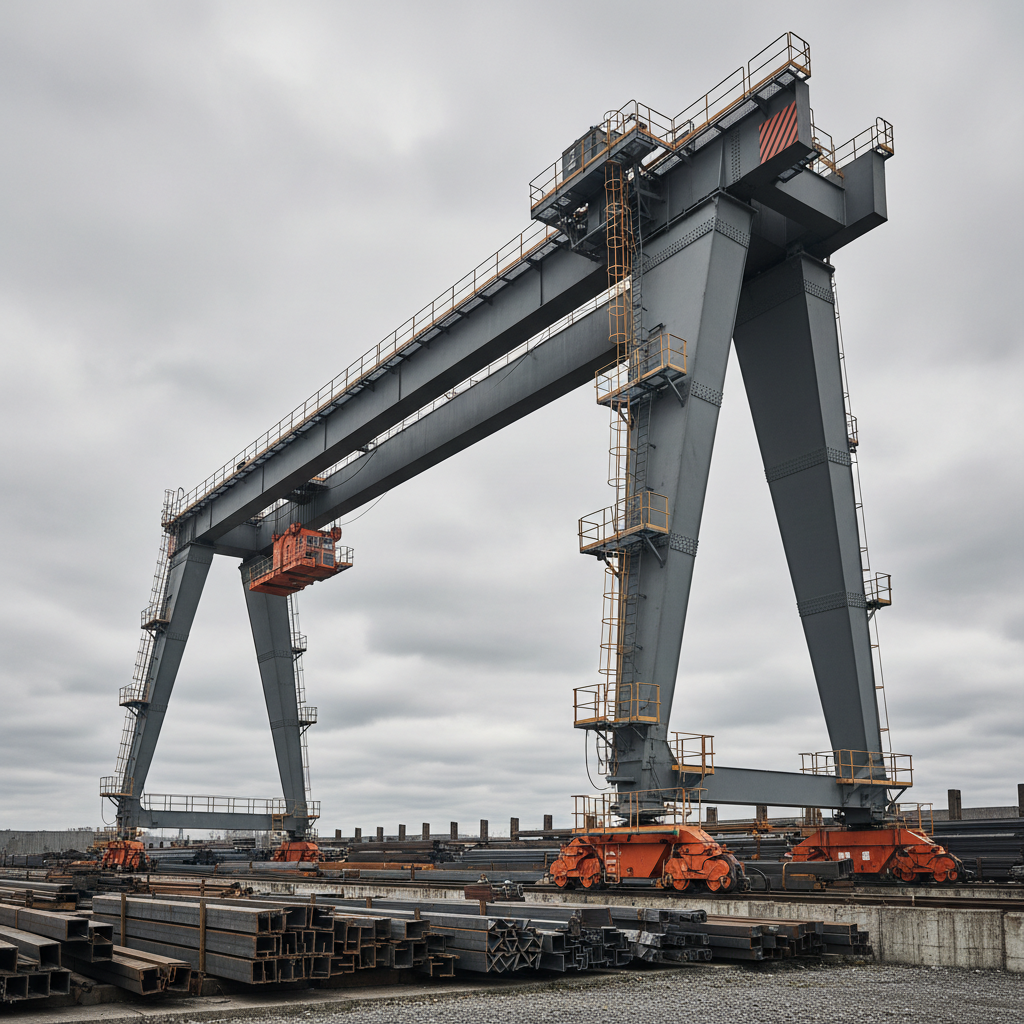
Gantry crane
A bridge girder carried on two legs that run on rails set in the floor or on the ground. Because a gantry brings its own support structure, it works outdoors, in yards, and in buildings whose walls and columns cannot take crane loads. Rubber tired versions trade the rails for wheels and go anywhere the surface allows.
Strengths
+Needs no building or elevated runway to carry it
+Works outdoors over laydown yards and rail spurs
+Available in single or double girder, light to very heavy
Trade-offs
−Legs occupy floor space and constrain traffic
−Ground rails require a proper foundation and drainage
The hybrid
Semi-gantry crane
One end of the bridge rides on an elevated runway on a wall or column line; the other end rides on a leg down at floor level. It is the practical fix when only one side of a bay can carry crane loads, and it clears the floor along the elevated side while keeping the coverage of a full gantry.
Strengths
+Only one side of the building needs to take crane load
+Keeps floor clear along the runway side
+Can work under and around an existing overhead crane
Trade-offs
−Both support systems have to be aligned and level to each other
−The ground rail still needs a foundation
The workstation partner
Jib crane
A rotating boom on a floor mounted column or a wall bracket, covering a circle or an arc rather than a rectangle. A jib is not really a competitor to a girder crane; it is a complement. Putting jibs at individual machines or weld cells keeps short, repetitive picks off the bay crane so the bridge crane stays free for the long moves it was bought for.
Strengths
+Fast and simple for repetitive picks at one station
+Very low cost per lift point
+Frees the bridge crane for the moves only it can make
Trade-offs
−Coverage is a circle or arc, not the whole bay
−Floor mounted versions need a substantial foundation
Sizing
Capacity, span and hook height
Three numbers define the crane, and each one is measured differently than most buyers assume. Getting the definitions right is what separates a specification that produces comparable bids from one that produces six quotes for six different cranes.
01
Capacity is everything below the hook
Rated capacity has to cover the load plus the lifting beam, the grab, the magnet, the slings, and the fixture. That below-hook weight is the number most often left out of the arithmetic. Add a margin for the process change you cannot see yet, then round up to the next standard capacity rather than sizing to the exact worst case you have today.
Heaviest single load the crane will ever see
Weight of all below-hook devices and rigging
Margin for future process and product change
02
Span is rail centerline to rail centerline
Not the building width, and not the width of the area you want to cover. Span is fixed by where the runway can go, which is a structural question about which columns or walls will accept crane loading. Settle the runway location before you talk about span, because the two cannot be negotiated separately.
Measured between runway rail centerlines
Constrained by which columns can carry the load
End approach means the hook never reaches the full span
03
Hook height is a stack of clearances
Work from the lowest obstruction in the roof down through the bridge, the trolley, the hoist body, and the hook at its top position, then compare what is left against the tallest load you will lift over the tallest obstacle in its path. When the number comes up short, a low headroom hoist is almost always cheaper than modifying the building.
Lowest overhead obstruction sets the ceiling
Bridge, trolley and hoist all consume height
Verify lift over the tallest obstacle, not the floor
The detail that catches people out
End approach, sometimes called hook approach, is the distance from the runway rail centerline to the closest the hook can travel on that end. It is a real dimension of every crane and it means the usable coverage is always narrower than the span. If you need to lift a load sitting right against the wall, state that requirement in the specification and let the supplier propose the configuration that achieves it, rather than discovering the shortfall at commissioning.
Machinery
Hoist and trolley configurations
The bridge gets the load across the bay. The hoist and trolley do the actual work, and they are what your operators interact with every shift. This is where duty cycle matters most, because the hoist is the component that feels every start, stop and reversal.
Electric chain hoist
Light capacity, low to moderate duty, shorter lifts
A load chain running over a pocketed sprocket. Compact, inexpensive, and easy to service, but chain speed and heat limit it to lighter capacities and less demanding duty. Common on single girder cranes handling occasional lifts.
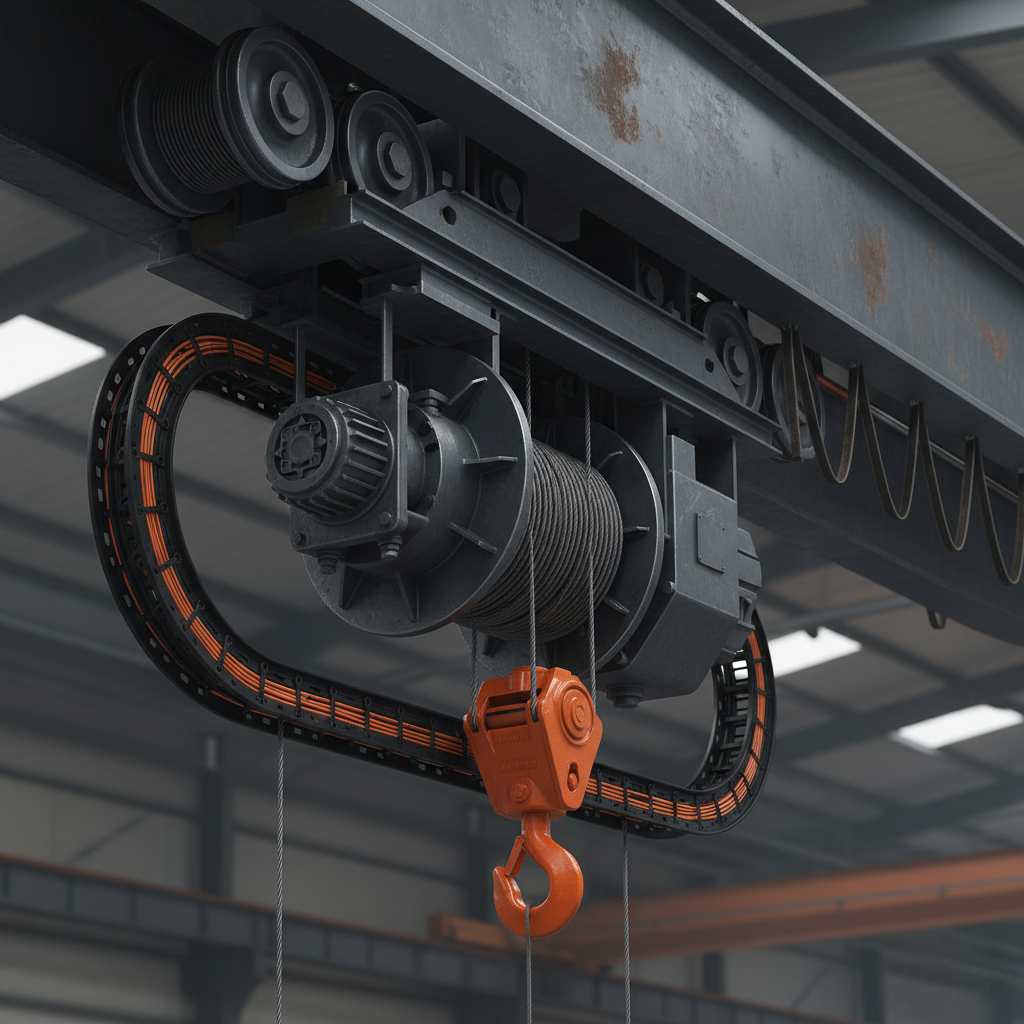
Electric wire rope hoist
Moderate to very high capacity, moderate to severe duty
Wire rope spooled on a grooved drum. Faster line speeds, longer lift heights, and far better heat rejection for repeated cycles. Available in a low headroom form that reclaims hook height on tight buildings, and in double reeved arrangements that keep the hook from drifting sideways as it lifts.
Manual chain hoist and trolley
Occasional lifts, no power available, minimal budget
Hand chain operation with a push or geared trolley. Still the right call for rarely used maintenance lifts, remote locations without power, and applications where lift speed genuinely does not matter.
Top running trolley
Rides rails on top of a double girder bridge. Gives the best hook height and lets you mount a cab, a magnet, a coil grab, or a rotating below-hook device without fighting for clearance.
Underhung trolley
Hangs from the bottom flange of a single girder. It costs less and weighs less, at the price of the hook height consumed by the trolley and hoist body sitting below the beam.
Low headroom trolley
A hoist packaged so the drum sits beside the trolley rather than beneath it, recovering hook height on buildings with unhelpful roof structure. Worth pricing before you conclude a bay cannot take the lift you need.
Dual hoist arrangements
Two hoists on one bridge for turning long or awkward loads, or a main and auxiliary pair where the small fast hoist handles routine work and the main hoist handles the heavy exception.
Speed and control matter more than buyers expect
Two-speed and variable frequency drives on the hoist, trolley and bridge are the difference between a crane that swings its load into position and one that places it. Variable frequency control also cuts shock loading into the structure and drive train, which shows up later as fewer repairs.
Anti-sway control, load display, and slow-speed micro positioning are worth pricing on any crane whose operators spend real time landing loads on machines or fixtures.
Support structure
The runway is half the project
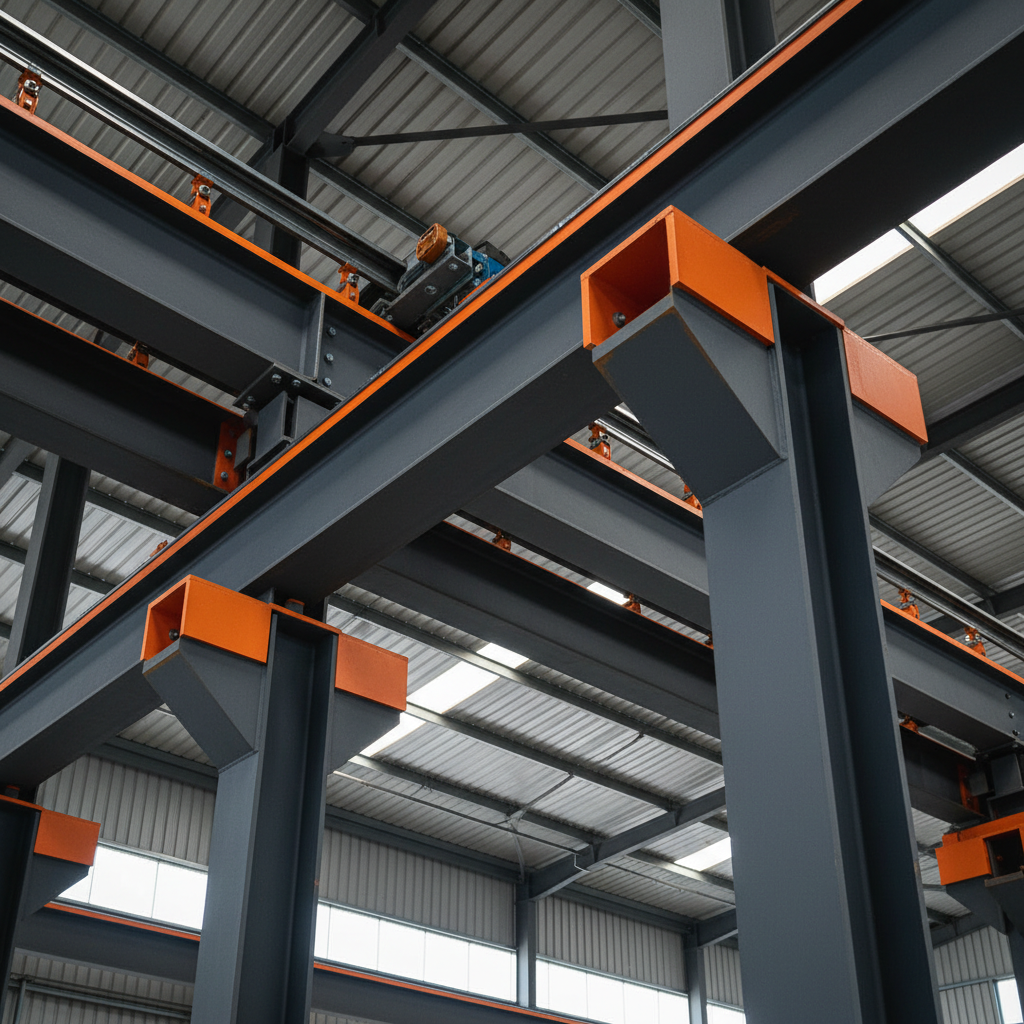
A girder crane is only as good as what holds it up. Runway beams, rails, brackets, stops and electrification are a distinct scope of work, and on a retrofit into an existing building they frequently cost more than the crane. Chronic crane problems are far more often a runway out of tolerance than a defect in the machine.
1
The runway beam is part of the crane purchase
Buyers routinely price the crane and forget that the beams, rails, brackets, stops and electrification carrying it are a separate scope. On a retrofit the runway is frequently the larger share of the project cost. Establish who is engineering it, who is supplying it, and who is installing it before you compare quotes.
2
Wheel loads, not crane weight, drive the design
What the structure has to resist is the maximum wheel load at each end truck with the trolley run to that end and the rated load on the hook, plus impact, plus lateral and longitudinal forces from acceleration and braking. Ask the crane supplier for a wheel load drawing early, because your structural engineer cannot start without it.
3
Deflection limits are about function, not just safety
A runway that meets strength requirements can still deflect enough to make the crane climb a grade as it travels, wear wheel flanges, and trip the drive. Vertical and lateral deflection limits are specified as a fraction of the span for exactly this reason and should be stated in your bid documents.
4
Alignment, elevation and rail condition
Span between rail centerlines, straightness, elevation difference side to side, and rail joint condition all have tolerances. Most chronic crane problems that get blamed on the crane are actually a runway out of tolerance, and a survey during commissioning gives you a baseline to compare against later.
5
End stops, bumpers and travel limits
Both the bridge on the runway and the trolley on the bridge need positive stops with energy absorbing bumpers sized for the travel speed. Where two cranes share a runway, add anti-collision detection rather than relying on operators to keep their distance.
6
Electrification and control
Conductor bar along the runway or festooned cable, plus the equivalent for the trolley. Decide early between pendant control, which ties the operator to the crane's position, and radio control, which lets the operator stand where they can actually see the load.
Duty cycle
Service classification
Two cranes of identical capacity and span can be built very differently depending on how hard they are expected to work. Service classification captures that: how many lifts per hour, how close to rated capacity the average lift runs, and how many load cycles the crane will accumulate over its life.
In North America the crane manufacturers' association publishes the classification most suppliers quote to; in Europe the materials handling federation publishes an equivalent scheme. Both express the same idea as a class designation. The practical point for a buyer is this: describe your real cycle rate to the supplier and require them to state the class they are quoting. Under-classifying a crane to save money buys you a machine that wears out early regardless of how well it was designed.
Duty level
Usage profile
Where it typically applies
Infrequent / standby
The crane exists for maintenance and breakdowns. It may sit unused for weeks and then lift near capacity a handful of times.
Regular use at well below rated capacity, with slow speeds and long idle periods between lifts.
Light assembly, service shops, warehouse pick and place
Moderate
Steady daily service averaging roughly half of rated capacity, with a consistent number of lifts per shift.
General machine shops, fabrication bays, paper mill areas
Heavy
Continuous work through the shift at or near rated capacity, with high duty cycles and frequent starts and stops.
Foundries, heavy fabrication, container and lumber handling
Severe / continuous
Around the clock production duty, often at capacity, sometimes in heat or with material that cannot wait for the crane.
Steel mill charging and scrap handling, magnet and grab service
What classification changes
Structural member sizing and fatigue allowances, hoist and gearbox selection, brake and motor duty ratings, wheel and rail sizing, and how often the crane has to be inspected.
How to describe your duty honestly
Count actual lifts per hour during a busy shift, estimate the average load as a fraction of rated capacity, and note whether the crane runs one shift or three. Guessing low here is expensive later.
When to classify up
If production is growing, if the crane is the only one serving a bay, or if a breakdown stops the line, buy the higher class. The premium is small next to unplanned downtime.
Through the life of the crane
Installation, inspection and maintenance
A crane is a piece of production equipment that people work underneath. Inspection intervals scale with duty class, records are part of the obligation rather than a formality, and the baseline you capture at commissioning is what makes later problems diagnosable.
Pre-shift operator checks
Every shift the crane is used
Before the first lift, the operator verifies that controls respond correctly in every direction, the upper limit stops the hoist, the brakes hold, and there is no obvious damage. Hook throat opening, latch condition, and rope or chain condition get a visual look. Anything that fails goes out of service, not on a list for later.
Frequent inspections
Daily to monthly, based on duty class
A more deliberate look at the items that change quickly: hoist braking, rope or chain wear and lubrication, hook deformation and cracking, limit devices, and any developing leak from a gearbox or hydraulic component. Severe duty cranes sit at the short end of the interval, standby cranes at the long end.
Periodic inspections
Quarterly to annually, based on duty class
The full equipment inspection: structural members and welds, bolted and riveted connections, sheaves, drums, shafts, couplings, bearings, gearing, brake linings, electrical apparatus, controllers, and the condition and alignment of the runway itself. This is where a rated load test typically belongs after repair or alteration.
Records and load testing
Ongoing, and after any major repair
Keep dated inspection records with the findings and the corrective action for each crane. New cranes, and cranes whose load-bearing components have been repaired or altered, are load tested before being returned to service, with the test documented and retained.
What a good installation sequence looks like
1Runway steel and rails set, aligned, and surveyed to tolerance
2Electrification run and end stops with bumpers installed
3Bridge assembled at floor level and lifted onto the runway
4Trolley and hoist set, controls and limit devices wired
5Full travel test, limit and brake verification, load test
6Runway survey recorded as the baseline for future checks
7Operator and maintenance training, documentation handed over
Specific inspection intervals, load test procedures and recordkeeping obligations are set by the governing standards and by workplace safety regulations in your jurisdiction. Confirm the current requirements that apply to your site rather than relying on a general summary.
Questions
Girder crane FAQ
What is the practical difference between a single girder and a double girder crane?
Cost and hook height, mostly. A single girder crane hangs its hoist under one beam, which is cheaper to buy and lighter on your building, but the trolley body sitting below the girder eats hook height and limits how close the hook gets to the runway on each end. A double girder crane carries the trolley on top of two beams, buying back that hook height and the space to mount cabs, magnets, and heavy below-hook equipment. Below roughly 20 tons in light to moderate duty, single girder is usually the value choice. Above that, or where lift height is tight, double girder tends to win.
How do I determine the span I need?
Span is the distance between runway rail centerlines, not the width of the building and not the width of the area you want covered. Fix the runway location first, because that is a structural decision about which columns or walls can take crane load. Then verify what the hook actually reaches: end approach dimensions mean the hook cannot travel the full span, and that dead zone at each end is often the detail that ruins an otherwise correct crane.
What capacity should I specify?
Start from the heaviest single load the crane will ever lift, then add the weight of everything hanging below the hook: the lifting beam, the coil grab, the magnet, the slings, and the fixture. Round up to a standard capacity rather than sizing tight to your current maximum. The premium for the next standard capacity up is generally modest compared to what it costs to discover in three years that your process changed and the crane cannot handle it.
How much headroom does an overhead crane need?
It depends on the configuration, and this is exactly what a low headroom hoist exists to solve. The stack that matters runs from the lowest obstruction in the roof structure down through the bridge, the trolley, the hoist body, and the hook at its highest position. If the arithmetic leaves you short, options in rough order of cost are a low headroom trolley, a single-to-double girder change, raising the runway elevation, or modifying the building.
What are crane service classes and why do they matter?
Service or duty classification describes how hard the crane works: how many lifts per hour, what fraction of rated capacity it averages, and how many total load cycles it will see over its life. Standards published by the crane manufacturers' association in North America and by the European federation of materials handling both express this as a class letter or number. It matters because it drives structural sizing, hoist selection, brake and motor duty, and inspection frequency. A crane that is under-classified for the actual work will wear out early no matter how sound the design was. Have your supplier state the class they are quoting to, and describe your real cycle rate to them rather than guessing.
Can I add an overhead crane to an existing building?
Often, but the building governs the answer. Two paths exist: hang an underhung crane from the roof structure, which requires a structural engineer to confirm the existing framing can take the load, or build a free-standing runway on its own columns and footings inside the building, which is more expensive but does not depend on the existing steel at all. A semi-gantry, with one elevated runway and one floor-level leg, is the middle path when only one side can carry load.
Pendant control or radio control?
Radio control, in most cases. A pendant ties the operator to the crane's position, which means walking with the load and often standing where the view of the landing point is worst. Radio lets the operator pick the safest position with the best sight line. Pendants still make sense where radio traffic is a problem, where the operating environment is hostile to a transmitter, or where the crane is used so rarely that battery management becomes the bigger nuisance.
What does a girder crane installation actually involve?
Runway steel and rails go in first, are aligned and surveyed, and get their electrification run. The bridge is assembled and lifted onto the runway, the trolley and hoist are set, and controls and limits are wired and commissioned. Then the crane is tested through its full travel and load tested, the runway survey is recorded as a baseline, and operators and maintenance staff are trained. Plan on production disruption during the lift itself and schedule it accordingly.
How long does an overhead crane last?
Structurally, decades. The bridge and runway of a properly classified, maintained crane routinely outlive the process they were bought for. What ages out first is mechanical and electrical: brakes, wire rope, gearboxes, contactors, and control systems. Modernization, which keeps the structure and replaces the drives, controls, and hoist, is frequently a fraction of the cost of a new crane and is worth pricing before you replace an old machine that is still structurally sound.
Get a Quote
Tell us what you need to lift
Send the load, the span between your runway centers, the available headroom, and roughly how many lifts a shift the crane will make. We will connect you with manufacturers who can configure the right fit and answer the questions your bidders are going to ask you anyway.
Specification review
Bring a draft spec and qualified manufacturers can review it with you before it goes out to bid.
Retrofit feasibility
Adding a crane to an existing building, and unsure whether the structure will take it.
Replacement or modernization
Deciding whether an aging crane is worth modernizing or should be replaced outright.